
What Is the Standard Algorithm? (October 2026)
A lot of parents watch their child work through a column addition problem and can't quite tell if the steps make sense to them or if they're just moving digits around. That gap between doing the procedure and understanding it is what trips kids up later. The standard algorithm actually has solid reasoning behind every step, and once you see it laid out clearly, it's much easier to spot where a child is getting lost.
TLDR:
- The standard algorithm for addition stacks numbers vertically and works right to left, carrying when any column hits 10 or more.
- "Regrouping," "carrying," and "traditional algorithm" all describe the same procedure, just named differently by era or curriculum.
- Most standards expect 2-digit regrouping in 2nd grade, 3-digit in 3rd, and full fluency with multi-digit addition and subtraction by end of 4th.
- Mastering the procedure builds mental math without replacing it; place-value fluency carries over to decimals and harder operations.
- The Super Teacher app sequences standard algorithm lessons from 2-digit addition through subtraction with borrowing, with every lesson vetted by former elementary school teachers.
What the Standard Algorithm for Addition Actually Is
The standard algorithm for addition is a step-by-step method for adding numbers by stacking them vertically and working column by column from right to left. When any column's sum exceeds 9, you carry the extra value into the next column to the left. That carried digit represents regrouping.
When you first teach addition to kindergarteners, the ideas stay simple. With larger numbers, to add 348 + 275, you write one number above the other, lining up ones, tens, and hundreds. Add the ones first (8 + 5 = 13), write the 3, carry the 1. Then tens (4 + 7 + 1 carried = 12), write the 2, carry the 1. Then hundreds (3 + 2 + 1 = 6). Answer: 623.
The word "standard" just means it's the widely agreed-upon procedure taught in schools across the U.S.
The Standard Algorithm vs. Other Names for the Same Thing
You may see this method called the "traditional algorithm," "column addition," or simply "carry the 1." In older workbooks it sometimes appears as "addition with regrouping." These are all the same procedure, named differently depending on the decade, the curriculum, or the grade level.
"Regrouping" is the term most elementary teachers use now because it more accurately describes what's happening: you're reorganizing a value across place-value columns, not simply moving a stray digit. "Traditional algorithm" and "standard algorithm" are essentially interchangeable, though "standard" is the term most common in current U.S. math standards.
If your child's teacher says "regrouping" and you remember "carrying," you're talking about the same step.
How the Standard Algorithm for Addition Works, Step by Step
Start with a problem that needs no carrying, just to see the structure clearly.
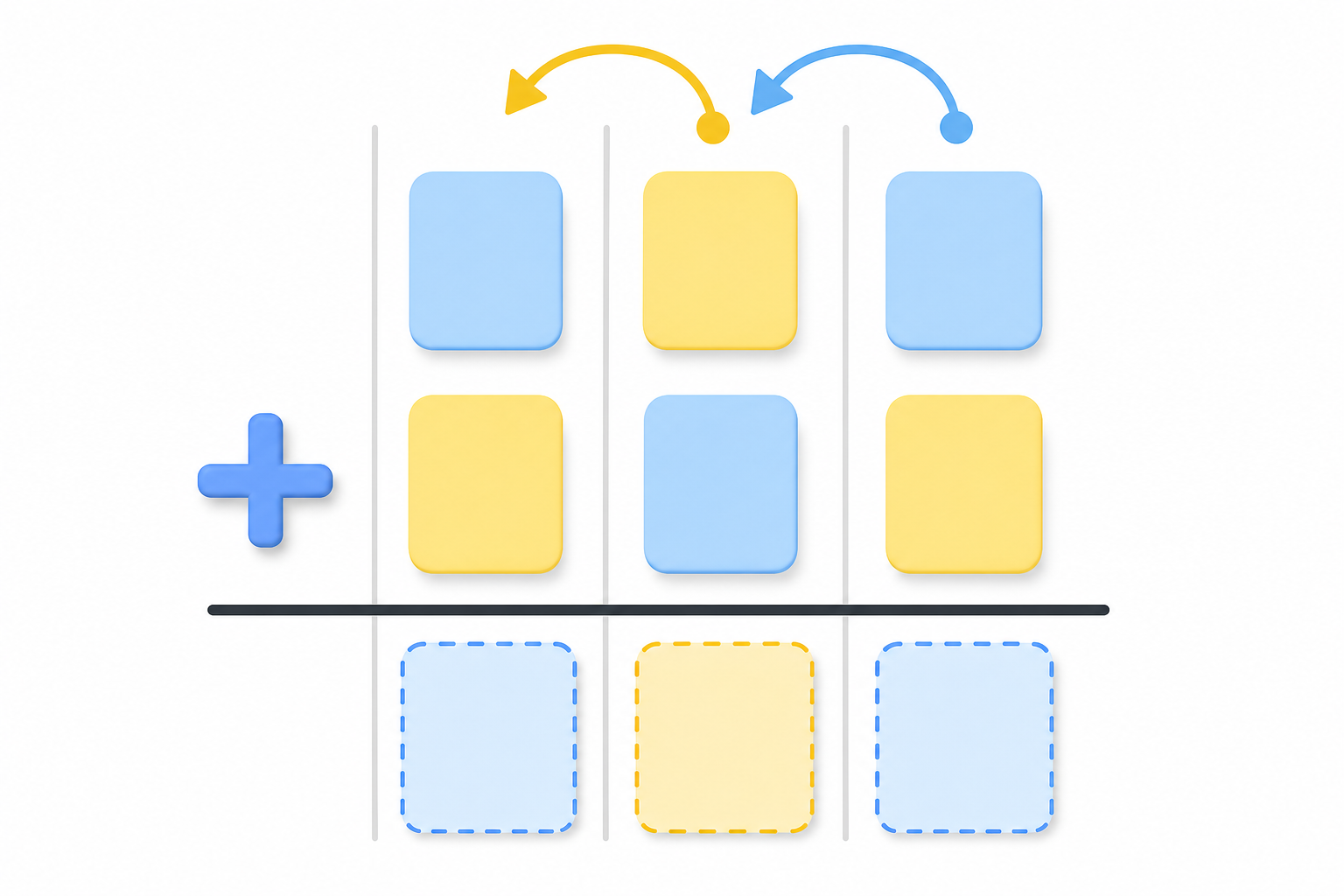
Take 23 + 34. Stack them with the ones column on the right: 3 + 4 = 7, then 2 + 3 = 5. Answer: 57.
Now add carrying: 26 + 37. Ones: 6 + 7 = 13. Write the 3, carry the 1 to the tens column. Tens: 2 + 3 + 1 = 6. Answer: 63.
A 3-digit example: 348 + 275. Ones: 8 + 5 = 13, write 3, carry 1. Tens: 4 + 7 + 1 = 12, write 2, carry 1. Hundreds: 3 + 2 + 1 = 6. Answer: 623.
Look back at those carried digits in 26 + 37 and 348 + 275. Each one is a real quantity, not a mark scribbled above a column out of habit. The 1 carried from the ones column is a group of ten, and in the hundreds example, a group of ten or a hundred, that outgrew its column and had to move left. The small number written above is a reminder that it is waiting to be added.
Place Value Is the Concept Behind the Algorithm
Every digit in a number holds a position, and that position determines its value. The 3 in 37 means thirty. The 3 in 300 means three hundred. The standard algorithm forces a child to work with this distinction on every single problem.
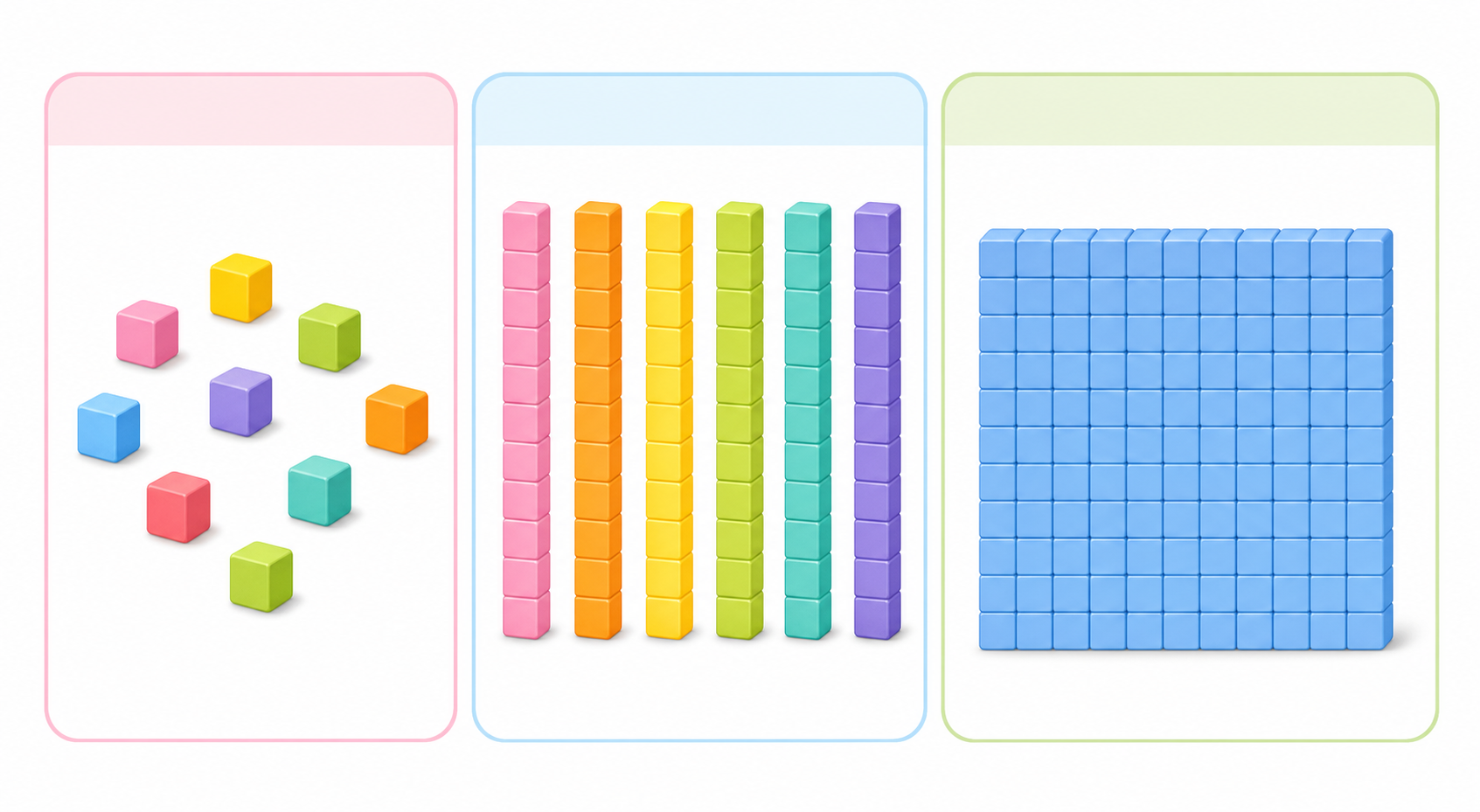
When a child adds the ones column first, then the tens, then the hundreds, they are practicing the idea that these columns are separate and hold different values. Carrying a 1 into the tens column is not shuffling an abstract symbol. That 1 represents ten ones that outgrew their column and needed to move left. Doing this repeatedly builds the place-value fluency that pays off later with decimals, where a child needs to understand why 0.3 and 0.03 are not the same.
When Regrouping Is Required (and Why It Works)
Regrouping kicks in whenever a column's digits add up to 10 or more. Take 57 + 68. Add the ones: 7 + 8 = 15. You cannot write 15 in a single column, so you split it: the 5 stays in the ones place and the 1 moves left into the tens column. That 1 represents one group of ten, which is exactly where it belongs.
Then the tens: 5 + 6 + 1 (carried) = 12. Write the 2, carry the 1. Answer: 125.
This works because 15 ones equal 1 ten and 5 ones. Regrouping is a trade: ten of one unit for one of the next unit up, placed where the place-value system can hold it.
Standard Algorithm for Subtraction: Borrowing Follows the Same Logic
Subtraction with the standard algorithm runs on the same place-value logic as addition, just in reverse. Instead of carrying a group of ten to the left, you borrow one from the left when the top digit is too small to subtract from.
Take 82 - 47. Start in the ones column: 2 - 7 won't work, so borrow a group of ten from the tens column. The 8 tens become 7 tens, and the 2 ones become 12 ones. Now 12 - 7 = 5. Move to the tens: 7 - 4 = 3. Answer: 35.
That borrowing step is regrouping in the other direction. One group of ten trades down into ten ones so the subtraction can proceed. A child who already understands why carrying works has the reasoning they need for borrowing, because the place-value system is consistent across both operations.
Non-Standard and Alternative Algorithms for Addition
Several methods show up in elementary curricula before or alongside the standard algorithm.
- Partial sums: add each place-value column separately, then sum the partial totals. For 348 + 275, you'd compute 300 + 200 = 500, 40 + 70 = 110, 8 + 5 = 13, then add 500 + 110 + 13 = 623. Every step stays visible.
- Expanded algorithm: each number is written out by place value before adding (300 + 40 + 8, then 200 + 70 + 5), making the column values explicit before any combining happens.
- Open number line: start with one addend and count forward in chunks. Less structured than column methods, but useful for building number sense early.
These methods are not shortcuts or workarounds. They slow the process down deliberately so children can see the place-value reasoning the standard algorithm compresses into a few small digits. A child who spends time with partial sums often understands carrying more clearly once they get there.
Why the Standard Algorithm Temporarily Fell Out of Favor (and What the Research Shows)
For a period, some curricula delayed the standard algorithm out of concern that memorizing a procedure would shortcut genuine understanding. The worry was reasonable: a child who carries digits without knowing why isn't really doing math.
The research, though, pointed the other way. Project Follow Through, one of the largest federally funded educational studies ever conducted, found that direct, structured instruction consistently produced better outcomes than discovery-based approaches, particularly for students who were behind or at risk, a finding that sits at the center of the evidence behind direct instruction. That debate over procedure versus understanding hasn't fully settled, as Wikipedia's overview of standard algorithms notes, but most researchers now agree procedural fluency and conceptual understanding reinforce each other rather than compete. Teaching the standard algorithm clearly, with the place-value reasoning explained alongside it, builds both.
The Standard Algorithm Builds Mental Math, Not Replaces It
Drilling the standard algorithm on paper does not wire a child to reach for a pencil forever. Knowing the procedure cold means knowing how numbers break apart by place value, and that knowledge transfers directly to mental math.
Take 555 + 222. A child who understands why the algorithm works can see it mentally: 500 + 200, 50 + 20, 5 + 2, arriving at 777 without writing a single digit. The algorithm built the foundation for that thinking.
Procedural fluency and mental flexibility reinforce each other. The more automatically a child moves through the steps, the more mental bandwidth is free to notice patterns, estimate, and check answers.
What Grade Is the Standard Algorithm Introduced?
Common Core and most state standards follow a fairly consistent sequence. Two-digit addition with regrouping typically appears in 2nd grade. Three-digit addition with the standard algorithm is generally a 3rd grade expectation. By the end of 4th grade, students are expected to be fluent with multi-digit addition and subtraction using the standard algorithm. Massachusetts frames it this way, with addition and subtraction algorithms solidified before multiplication is introduced.
Grade | Standard Algorithm Expectation | Key Skill |
|---|---|---|
2nd Grade | Introduction | 2-digit addition with regrouping (carrying) |
3rd Grade | Building fluency | 3-digit addition with the standard algorithm |
4th Grade | Full fluency expected | Multi-digit addition and subtraction, including borrowing |
4th Grade+ | Extension | Multi-digit multiplication using the same place-value logic |
Some schools move faster, some slower. Getting comfortable with carrying and borrowing early leaves more mental room for the harder math that follows, which is part of why a solid pre-K readiness checklist pays off well before formal arithmetic begins.
How to Practice the Standard Algorithm at Home
Start where the child is, not where the worksheet says they should be. If carrying is shaky, go back to problems with no regrouping until the column-by-column process feels automatic. Then add one layer at a time.
A simple progression:
- 2-digit, no regrouping (23 + 45)
- 2-digit with regrouping (38 + 47)
- 3-digit with one carry (246 + 138)
- 3-digit with multiple carries (348 + 275)
- 4-digit column addition (1,346 + 2,587)
Start each practice session with about five problems and check accuracy before pushing for speed. Move on to harder problems only once answers are consistently correct. Printed worksheets work well for this because the column structure is already drawn in, and tutoring apps for kids can add structured practice between sessions. A quick dinner-table check-in is a light way to confirm the concept has stuck: give a problem out loud and have them walk you through it. If they can explain why they carried a digit, they understand it.
Confidence Follows Competence, Not the Other Way Around
Holding off on drills until a child "feels ready" often delays the very thing that would make them feel ready. Competence comes first. Confidence follows from it.
A child who can work through a column addition problem and get the right answer, reliably, starts to trust their own math ability. That trust is what makes the next harder topic feel approachable. Waiting for confidence to arrive before practicing the procedure has it backwards.
Our founder Tim Novikoff has watched this pattern play out again and again. Children who build real procedural skill stop saying they are bad at math, because their own correct answers tell them otherwise. That observation shaped what Super Teacher is: a personal tutor built to give kids enough practice to reach real competence, so the confidence shows up on its own.
How Super Teacher Teaches the Standard Algorithm
Super Teacher is a conversational tutoring app that teaches the standard algorithm the way a patient, knowledgeable tutor would: by working through problems step by step, asking the child questions out loud, and giving direct corrective feedback in the moment. Every lesson is crafted and vetted by former elementary school teachers on our staff.
The lessons are sequenced to build from the simplest cases up. A child starts with 2-digit addition without regrouping, advances to carrying into the tens and hundreds columns, and eventually works through subtraction with borrowing and 2-digit multiplication, all following the same place-value logic throughout. As each problem comes up, the child speaks their answer aloud, and the app uses voice transcription to understand exactly what was said, part of how Super Teacher works. That back and forth, hearing an answer and responding to it directly, is what makes a lesson feel like sitting with a patient tutor instead of clicking through a worksheet.
If a child stalls at the carry step, the tutor walks them through it without impatience, however many times it takes. Once the concept is solid, lessons shift into fluency practice designed to build the automaticity the algorithm depends on. That same patient, sequenced approach carries across every subject in the app, including reading skills like phonics and sight words, all part of the unlimited tutoring families get with a subscription. A full year of Super Teacher costs less than a single session with a traditional tutoring agency, and that subscription covers every child in the household.
Final Thoughts on Mastering the Standard Algorithm for Addition
Place value is the thread running through all of this, from the ones column all the way up. When your child understands why they carry a digit, and also how, the algorithm stops feeling like a rule to memorize and starts feeling like something that makes sense. That shift is worth being patient for.
FAQ
What is the standard algorithm for addition, and when are kids expected to learn it?
The standard algorithm for addition is the column-by-column method where you stack numbers vertically, add from right to left, and carry any value over 9 into the next column. Most students first see 2-digit addition with regrouping in 2nd grade, work with 3-digit problems in 3rd grade, and are expected to be fluent with multi-digit addition and subtraction by the end of 4th grade.
What's the difference between the standard algorithm and non-standard algorithms like partial sums or the expanded algorithm for addition?
The standard algorithm compresses all the place-value reasoning into a few small carried digits, while non-standard methods like partial sums or the expanded algorithm keep every step visible. Neither approach is a shortcut. The alternative methods slow the process down deliberately so children can see why carrying works before they do it automatically.
My child is struggling with carrying in column addition. What's the best way to practice the standard algorithm at home?
Start with 2-digit problems that require no regrouping until the column-by-column structure feels automatic, then add one layer at a time: 2-digit with carrying, then 3-digit with one carry, then multiple carries, then 4-digit column addition. Check for accuracy before speed, and ask your child to explain why they carried a digit. If they can answer that, they understand the place-value reasoning behind the procedure.
Standard algorithm addition vs. partial sums: which should my child learn first?
Spending time with partial sums first often makes carrying click faster, because the place-value reasoning the standard algorithm compresses stays visible at every step. The two methods are not competing. Most curricula use partial sums and the expanded algorithm as a foundation, then move to the standard algorithm once children understand what the carried digit actually represents.
How does Super Teacher teach standard algorithm addition and subtraction?
Super Teacher teaches the standard algorithm through a sequenced set of conversational tutoring sessions, starting with 2-digit addition without regrouping and building up through carrying, borrowing, and multi-digit problems, all following the same place-value logic. Children speak their answers aloud, and the app transcribes what they say to give direct, corrective feedback on the spot. If a child stalls at the carry step, the tutor walks through it without impatience until the concept is solid.