
How to Teach Addition to Kindergarteners — September 2026 Guide
Most kindergarteners can recite numbers just fine. What takes real work is getting them to understand what those numbers mean before you ask them to add anything at all. Once that clicks, the rest of how to teach addition to kindergarteners gets a lot more straightforward than you'd expect.
TLDR:
- Build number sense first: kids who skip one-to-one correspondence and subitizing struggle once problems get harder.
- Start with physical objects before written symbols, then ten frames, then number sentences in that order.
- Teach strategies like counting on and doubles before drilling any facts from memory.
- Five minutes of daily practice beats a long weekend session because the brain consolidates between reps.
- We recommend the Super Teacher app, which sequences number sense before addition, with 5-to-8-minute lessons vetted by former elementary school teachers.
Teaching Addition at Home Takes More Work Than It Looks
Everything in this guide works, but it takes time. Setting out counters, building ten frames, making up story problems, and knowing when your child is ready for the next step all take planning, and it's easy to get the order wrong without realizing it. Doing that five minutes a day on top of everything else is a lot to ask.
A good tutoring app can help. The best ones follow a clear teaching sequence and give feedback in the moment, though many math apps for young kids are closer to drill games than real teaching.
Super Teacher is a tutoring app for children ages 3 to 10 that works like a personal tutor. It talks with your child, listens to their spoken answers, and adjusts as they go. The math course starts with number sense before addition, every lesson is vetted by former elementary school teachers, and 5-to-8-minute lessons let your child practice on their own. Use it alongside the strategies below or on its own, whichever fits your family.
Why Number Sense Comes Before Addition
Addition looks simple from the outside. Two numbers, one answer. But for a kindergartener who doesn't yet understand what "five" actually means, the operation is hollow.
Number sense at this age comes down to a few specific skills. One-to-one correspondence is the ability to count objects by touching each one exactly once, beyond simply reciting numbers from memory. Cardinality means knowing that the last number you count tells you the total. Subitizing is the ability to "see" a small group of objects and know how many without counting at all. Kids develop these at different rates.
Research on early numeracy shows that building number sense in the preschool and primary-grade years provides the foundation for addition fact fluency later on. A child who skips this stage can often get by early on by counting fingers, but runs into trouble once the numbers get bigger and the problems get faster.
What Kindergarteners Are Ready to Learn
Most kindergarteners start the year working with numbers up to 10, and by spring, sums to 20 become the stretch goal. A child who can reliably add 3 + 4 by counting on from the larger number is doing exactly what's expected.
Working memory is limited at this age. Kindergarteners can hold only a small number of pieces of information at once, which is why single-digit addition is the right starting point. Pushing into double digits too early tends to produce guessing instead of understanding. Keep the numbers small, let the understanding build, and the range expands on its own. Parents looking for extra practice may want to look into math apps for kindergarten that reinforce these early concepts.
Start with Concrete Objects and Manipulatives
Before a kindergartener writes "2 + 3 = 5," they need to push two blocks toward three blocks and count what's there. The concept has to live in their hands first.
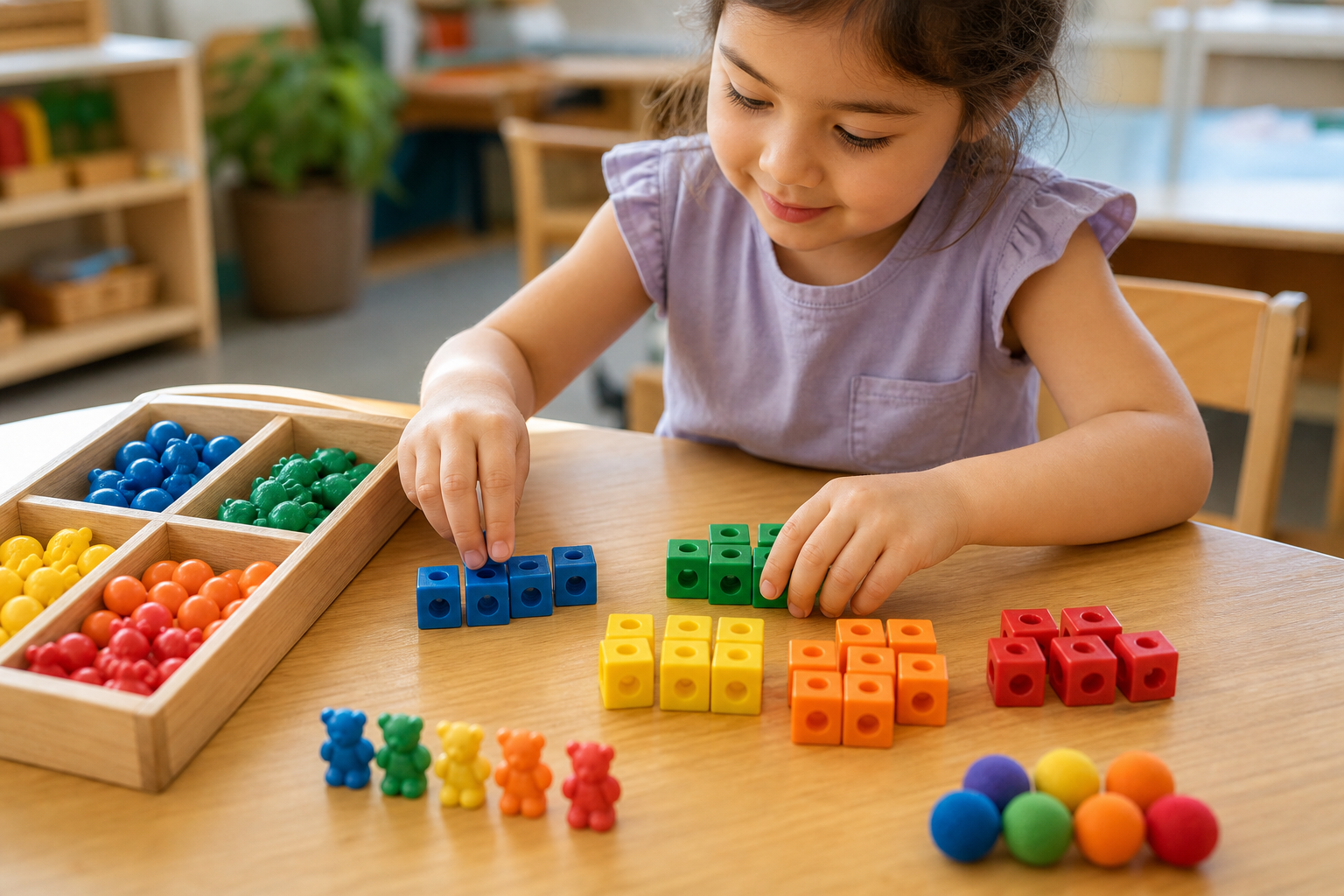
This is the concrete-to-pictorial-to-abstract progression. Physical objects come first, then pictures of those objects, then number symbols. Skipping straight to symbols is where a lot of early addition instruction goes wrong. The Education Endowment Foundation notes that manipulatives help children represent mathematical ideas in ways they can see and touch before moving to abstract forms, a principle that science-grounded tutoring takes seriously.
You don't need special equipment. Put four beans on the left side of a plate, two on the right, slide them together, and count. That physical act of combining two groups is exactly what addition means.
Use Ten Frames to Build Visual Understanding
A ten frame is a simple grid: two rows, five squares each. The structure gives a child a fixed visual boundary to work against, so they're not counting into empty space.
To add 6 + 3, a child places 6 counters into the frame (filling the top row, then one in the second row), then adds 3 more. They can see the frame is nearly full, one square short of 10. That visual relationship between the total and the boundary of 10 plants the seed for the Make 10 strategy later, where children use combinations that make ten to solve harder facts, as Math Coach's Corner explains.
Problem | Ten Frame Setup | What the Child Sees |
|---|---|---|
6 + 3 | 6 counters filled, add 3 | 9 total, one empty square |
7 + 2 | 7 counters filled, add 2 | 9 total, one empty square |
8 + 4 | 8 filled, add 2 to reach 10, then 2 more | 10 + 2 = 12 |
The frame makes "nearness to 10" visible before a child can put it into words.
Teach Addition Strategies Step by Step
Memorization is the wrong first goal. What a kindergartener needs is a reliable thinking method they can fall back on when a fact isn't automatic yet.
- Counting all: put out 3 blocks, put out 4 more, count the whole group. Slow, but it works and builds the concept.
- Counting on from the larger number: for 3 + 6, start at 6 and count up three ("seven, eight, nine"). Faster than counting all.
- Doubles: 2+2, 3+3, 4+4 are easy to picture and worth learning early. They also open the door to near-doubles like 3+4.
- Zero facts: anything plus zero stays the same. Simple rule, worth making explicit.
As Lucky Little Learners notes, addition strategies give students tools to solve problems while building number sense. The sequence matters. A child who hasn't solidified counting all isn't ready to count on. Let each strategy settle before introducing the next.
Introduce Addition Through Stories and Word Problems
A number sentence floats without context for a five-year-old. "3 + 2 = ?" is just symbols. But "three ducks are on the pond, and two more fly in" is something a child can picture.
Start orally. Tell the story, act it out with counters if you have them, and ask the question before any paper appears. Let the child hold the math in their head as a situation, not a procedure. Once they've answered it that way a few times, writing "3 + 2 = 5" becomes a record of something they already understand, not a mystery to decode.
Keep the stories simple and concrete: animals joining a group, apples going into a basket, kids sitting at a table. The context should be familiar enough that the child isn't spending mental effort on the scenario itself.
Word problems also reveal whether a child actually understands addition or is just pattern-matching symbols. A child who can solve "2 + 4 = ?" but freezes when you say "two birds are in a tree and four more land, how many now?" hasn't fully connected the operation to its meaning yet. Story problems close that gap.
Make It Physical with Games and Activities
Repetition builds fluency, but a five-year-old doesn't sit still for worksheets. Games get the same reps in without the resistance.
A few activities that work well in both classrooms and homeschool settings for ages 3 to 10:
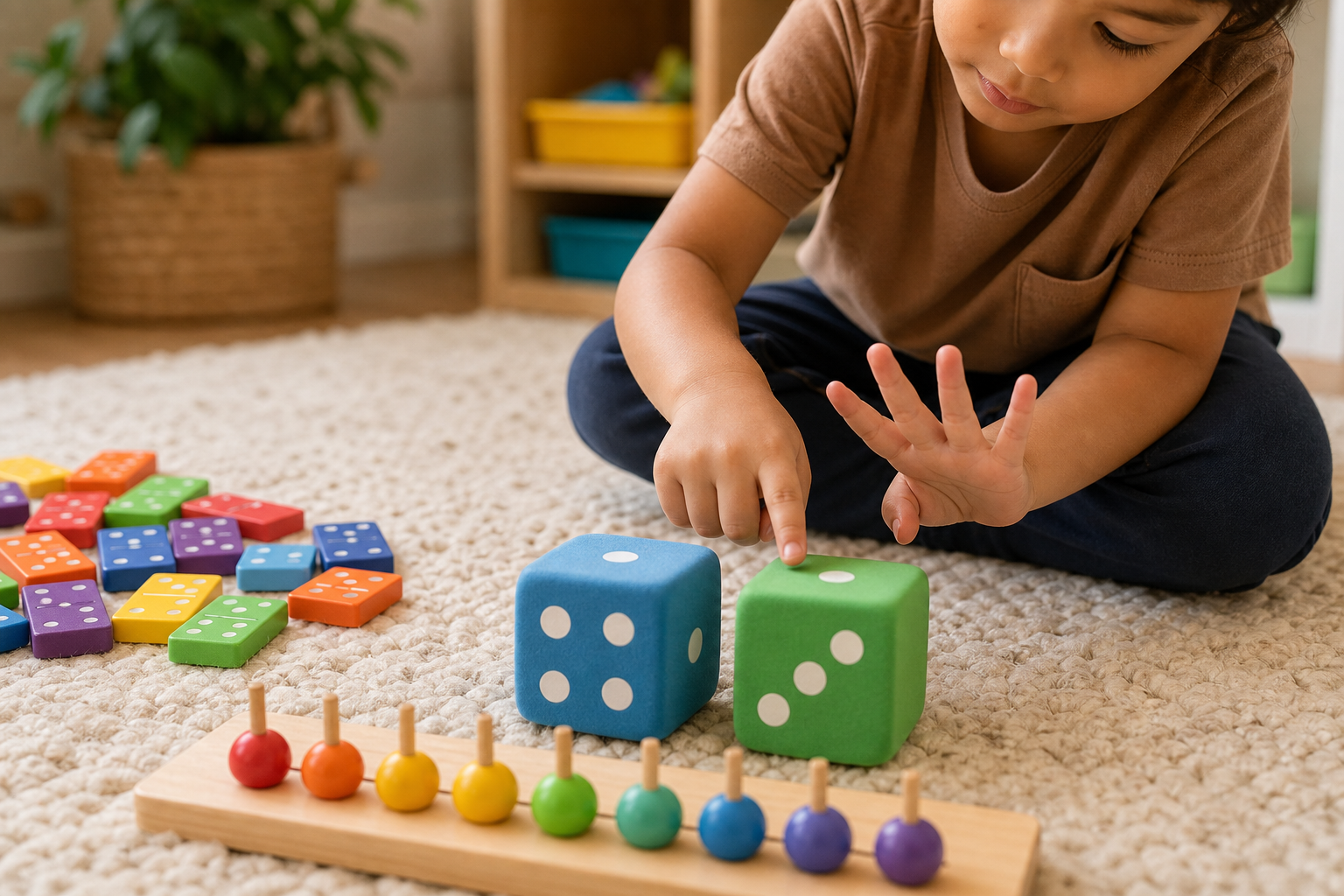
- Dice addition: roll two dice, add the dots. No setup, immediate feedback, and the random element keeps kids coming back. Use foam dice to cut down on the chaos.
- Domino addition: flip a domino, count the dots on each side, combine them. Dominoes are slower-paced than dice, which works better for kids still on counting all.
- Snap cube towers: build a tower of 4 cubes, snap on 3 more, count the full tower. The physical act of connecting pieces reinforces combining two groups.
- Number line walks: draw a number line on the floor with tape. A child stands on 5, takes 3 steps forward, lands on 8. Their body is the counter.
When a child rolls dice and shouts out the answer, they're doing addition. They just don't feel like they are.
Add Songs, Chants, and Rhythmic Practice
Rhythm is not a motivational trick for young learners. It is how the brain at this age stores and retrieves information. When a child hears a pattern repeated with a beat, the sequence gets encoded differently than a fact recited in silence. That is why a kindergartener who cannot reliably answer "2 + 3" might still nail it when it lands inside a familiar chant. Parents seeking structured support beyond these activities can find a breakdown of tutoring apps for young kids that fit this approach.
A few examples worth trying:
- Counting-on chants: call out "start at 4" and have the child count on with claps ("5... 6... 7") while holding up fingers for each step. The physical rhythm and the spoken count reinforce each other.
- Call-and-response doubles: say "two plus two" with a clap, and the child answers "four" on the next beat. Run through 1+1 through 5+5 this way. Doubles are easy to picture, and the rhythm drives them in faster than repetition alone.
- Zero-fact chant: "add a zero, stay the same" repeated as a short sung phrase. Children internalize the rule before they can explain it.
The goal is repetition that does not feel like repetition.
Build Toward Fact Fluency Without Forcing Memorization
Fact fluency and memorization are not the same thing, and the difference matters more than it seems. A child who has memorized "5 + 3 = 8" by rote has one fact stored. A child who can count on from the larger number, picture a ten frame, or apply a doubles-plus-one shortcut has a method that works for facts they have never drilled. Fluency built on strategies scales as numbers get bigger; a memorized fact just ends. Families looking for digital support can compare tutoring apps for kids that focus on building strategies over drilling rote recall.
A child who has memorized "5 + 3 = 8" by rote has stored one fact. A child who can count on from 5, picture the ten frame, or use a doubles-plus-one shortcut has a method that works for facts they haven't drilled yet. When the numbers get bigger, the method scales. The memorized fact just ends.
That said, fluency is still the goal. A child who reaches 8 quickly, without visible effort, is where you want them. Strategies practiced enough become automatic over time, but that repetition has to be spread out.
Short daily practice beats long occasional sessions for kindergarteners. Five minutes of addition at breakfast is worth more than thirty minutes on a Saturday. The brain consolidates during the gaps between practice, not during the practice itself.
Automaticity with small facts like 5 + 5 or 3 + 4 is the scaffold for everything harder. A child who knows those instantly has working memory free to handle subtraction, then multiplication, then fractions. A child still counting dots at the third-grade level is spending that capacity just to get through the first step of a multi-part problem.
Common Mistakes When Teaching Addition to Young Children
Four patterns come up again and again when adults teach addition to young children.
Moving to written number sentences too early is the most common. When a child writes "4 + 3 = 7" without having first combined actual objects, the symbols carry no weight. The physical step is the actual instruction, not optional warm-up.
Expecting memorization before a child has solid strategies is the second. Drilling "3 + 5 = 8" before a child can count on from the larger number gives them a fragile fact with nothing to fall back on. Strategies first, automaticity later.
Correcting too quickly is subtler. A five-year-old working through "6 + 2" needs a few seconds to think. Jumping in short-circuits exactly the reasoning you want them to practice.
Last: conflating wrong answers with inability. A child who says "6 + 2 = 9" is probably one count off, not lost. That error tells you where their thinking broke down, which is useful. Treating it as evidence they "can't do math" is where the real damage happens. Resources designed for parents can help with spotting these patterns and responding constructively.
How Super Teacher Approaches Kindergarten Addition
Super Teacher is a tutoring app for children ages 3 to 10 that works like a one-on-one tutor, not a game or a worksheet. The app speaks directly to your child, asks questions out loud, listens to their spoken answers, and adjusts the lesson based on how they respond. Every lesson is vetted by former elementary school teachers on staff, so the instruction your child gets reflects real teaching judgment, not guesswork.
The Super Teacher adaptive lesson system responds inside each lesson: a child who struggles gets more scaffolding and simpler task variants right away. A child who's ready gets a challenge question. No waiting until the next session.
One household account covers every child in the family, and a full year of Super Teacher typically costs less than a single session with a traditional tutoring agency. See the full details on unlimited tutoring for your family.
Final Thoughts on Teaching Kindergarten Addition
Start slow, stay concrete, and trust the process. Your child is building something real when they push blocks together and count, even if it looks like play. The facts your child internalizes now free up the mental space they'll need for every math concept that comes after this one.
FAQ
What's the best way to teach addition to a 5-year-old?
Start with physical objects before anything written appears. Let a child push two groups of blocks together and count the total before they ever see a number sentence. Once they can do that reliably, move to pictures, then to symbols like "2 + 3 = 5." Skipping the hands-on stage is where most early addition instruction breaks down. If you want guided support that follows this exact sequence, the Super Teacher app structures every math lesson to move through concrete understanding before written symbols, with short 5-to-8-minute sessions taught by a voice tutor vetted by former elementary school teachers.
Can a kindergartener start learning addition before they fully know how to count?
Not quite. A child needs to understand what numbers actually mean before addition makes sense. One-to-one correspondence (touching each object exactly once while counting), cardinality (knowing the last number counted is the total), and subitizing (recognizing small quantities at a glance) all need to be in place first. A child who can recite numbers but lacks those skills will get by early on with finger-counting, then hit a wall when the problems get faster and the numbers get bigger.
How do I build addition fact fluency in kindergarten without just drilling memorization?
Teach strategies first: counting all, counting on from the larger number, doubles, and zero facts, in that order. Each one gives a child a method that works even for facts they haven't practiced yet. Fluency follows from strategies practiced enough times to become automatic, and short daily practice (five minutes beats a thirty-minute session once a week) is what builds that repetition without burning a five-year-old out.
How does Super Teacher teach addition to kindergarteners compared to drill-and-practice apps like IXL?
Super Teacher follows the full "I do, we do, you do" sequence: the tutor models the skill, works through it with the child using scaffolding, then the child practices independently. The math progression also starts with number sense before any addition appears, so children have the foundation those operations actually require. Lessons run 5 to 8 minutes and adapt inside each session, giving struggling children more scaffolding right away and offering challenge questions to children who are ready.
What does a ten frame do that a regular worksheet can't?
A ten frame gives a child a fixed visual boundary to count against, making "nearness to 10" visible before they can put it into words. When a child places 8 counters in a frame and adds 4 more, they can see they need 2 to fill the frame and have 2 left over, which is the Make 10 strategy in action. A blank worksheet has no structure to anchor that reasoning.